


Escaping the Data Vampires

Holistic Remedies for a Broken Metaverse

The metaverse has died, and not for the first time. Promises of virtual worlds where everyone is equal, friendly, and empowered generally turned out to be hollow marketing campaigns. Most efforts to make a “game-changing” platform ran well over budget, under-delivered on features and funnelled the details of our interests, interactions and friendships to data-hungry tech companies. This data is sold to other private interests or used to influence, persuade or nudge people toward preferential behaviours. Psycho-social wellbeing is not a major concern.

While it’s not true that every virtual experience exists to sell your data on back channels and drive revenue to the pay-per-click vampires of the modern web, the backdrop is, all too frequently, an aggressive profit generating strategy that prioritises investor wealth over user experience. Descriptions of “decentralised” systems are greeted with excitement by those who see profit, and suspicion by those who watch the rug-pulls and scams that are so regularly touted as the basis for Web3, whatever that is.

Is it any surprise that, when we are laser-focused on ‘ownership’ but give little attention to the value of the things that we own, we end up with rampant greed and a market flooded with worthless tokens and quasi-fungible pixel art? Though this picture might seem bleak, we believe that there are other ways to think about decentralisation, ownership and the immersive experience that do not require you to pass a retinal scan, hand over yet more money to a billionaire or pick up a brand new dopamine habit.

When we talk about decentralisation, we mean that the control of the technology is not in the hands of a few. Just as the internet can be used by any compatible machine, so immersive online experiences can be built by anyone with the right tools. This is made easier because all of these tools already exist and are freely available, but we’ll get to that later.

True ownership, we believe, has no strings attached. In our world, it means self-hosting, sole control over the code and the ability to add and remove functionality to the virtual space. It also means taking responsibility, both for the content and the cost of computation, which is low.

The immersive experience — that is, the one seen in three dimensions and felt with six degrees of freedom — connects the realms of normal physical interaction and digital content. In VR we create (episodic) memories of people, places and the things we did there. We can talk with our hands and design spaces that help us think and share ideas.

It is, of course, not enough to cast a dreamy vision of a blissful future into the hypothetical air. Software must be built and tested, by developers who work for companies. These principles, therefore, must also be reflected in the project organisation, the human cooperation and the software architecture. That’s right, even the code looks different when the concepts change.

The Island Collective set out to make this a (virtual) reality, and we did.

The Island Collective is a network of VR-ready experiences, each running securely on the Internet Computer and, like any other website, accessible with just a link. Here we will present some of the key features, describe how they work and, hopefully, persuade you to go and try it for yourself. Later you will learn how to make your own space, but all in good time.

Arriving on The Island, the first thing you will notice is the soothing tropical vibe; the sound of waves lapping at the shore and the warm glow of an eternal sunset. Spatial sound and the ability to layer and bake lighting mean that experiences can be fine-tuned for immersive quality. The use of the Unity engine makes doing this a fun and artistic process.

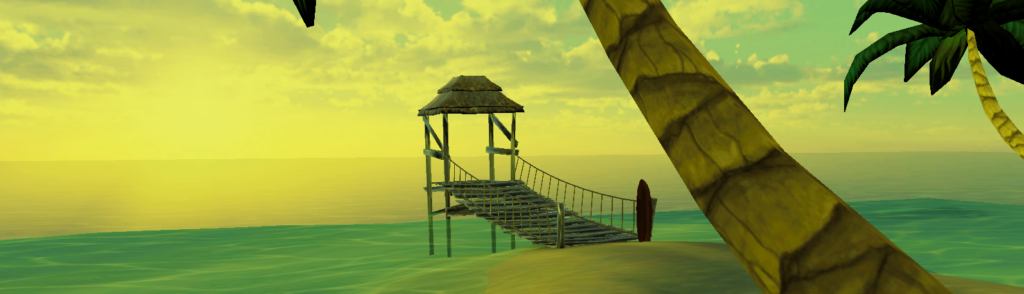
Turning around and strolling down the dock brings you on to dry land. The controls for the VR joysticks and buttons (or mouse/keyboard interaction) are custom-made and configurable. Since this is WebXR, this works on any headset or PC, via the browser, and is accessible from anywhere.

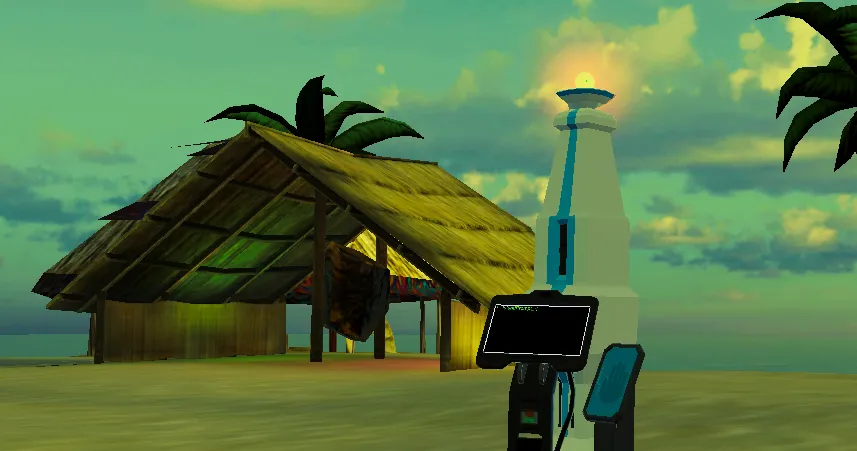
Soon you will arrive at the beacon, which is where you can switch between single and multiplayer modes. Activating it starts the peer-to-peer network, making a direct connection between your browser and anyone else visiting the space. This first version has some limitations, so we set a limit of six people to keep the quality of the experience high.
 

The Island has some entertainment, in the form of beach basketball. In this case, the physics is set up to give realistic feedback. Everything here is configurable, from the transfer of momentum from your hand to the ball during the shot, to the weight and drag during flight, and even the bounciness of different surfaces — you can make it as real or unreal as you like. We prefer a Jedi-style interaction in other situations.
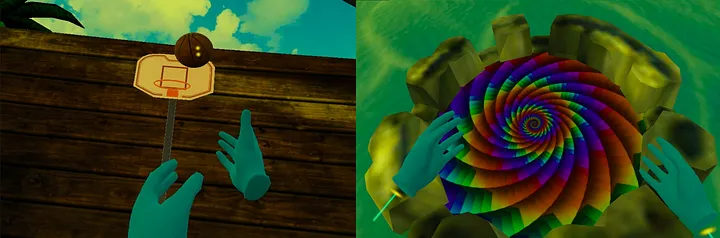
 

The last stop on this brief tour is a portal to another immersive experience. The portals work as links between places, transporting you to one of three other locations, each independently owned, operated and managed by its creator. Any number of collaborators can also be assigned ownership.

The features above are not just functions, but modules in a framework that allow anyone to (fairly) quickly construct an immersive space with physics, interaction and multiplayer components, and then self-host it on a distributed server network.
 

Visit The Island

This work was made possible with a grant from the DFINITY developer program, which offers non-dilutive funding for early projects.

About the Author

Leave a Reply

Your email address will not be published. Required fields are marked *

You may also like these

No Related Post